
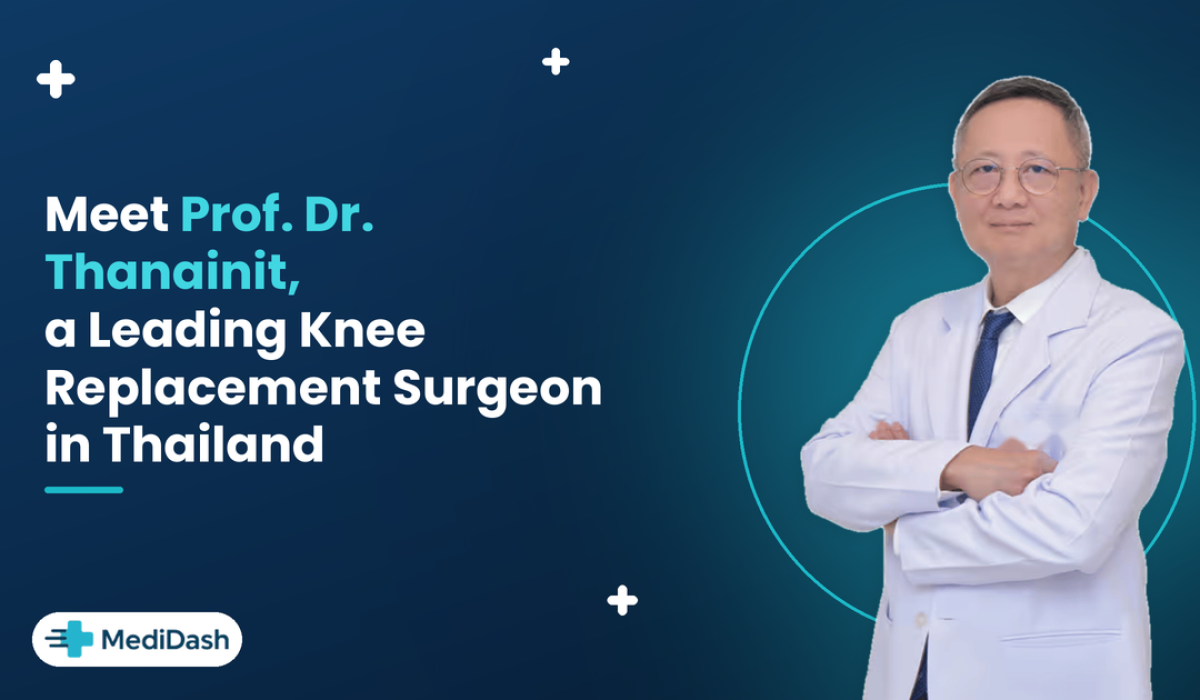
Choosing a knee replacement surgeon in Thailand is the decision international patients worry about most. The hospital matters, the price matters, but the person holding the instruments matters more. So we went to the source. Alex, our founder, sat down with Prof. Dr. Thanainit Chotanaphuti at Phyathai 2 International Hospital in Bangkok to ask the questions our patients ask us every week.
Prof. Thanainit is a hip and knee specialist with around 30 years of experience and, by his own count, close to 15,000 joint replacement surgeries. He has served as President of the Thai Hip & Knee Society and the ASEAN Arthroplasty Association. Below is what he told us about who should have surgery, what happens in theatre, how pain is managed and how long you will stay in hospital. His full credentials are at the end of this article.
Who Is Prof. Dr. Thanainit Chotanaphuti?
Prof. Thanainit is an orthopaedic surgeon at the Orthopaedic Institute of Phyathai 2 International Hospital. He qualified in medicine at Siriraj Hospital, Mahidol University, in 1985, earned his Thai Board certification in orthopaedic surgery in 1991, and completed an orthopaedic fellowship at Niigata University in Japan in 1992.
“I’m an orthopaedic surgeon, but my main specialty is hip and knee arthroplasty,” he told us. Arthroplasty is the clinical term for joint replacement. When we asked how long he has been operating, he said: “Now it’s around 30 years of experience, from the beginning, after I finished training.”
His answer to why he chose orthopaedics was refreshingly simple. He played tennis for his university team and has always liked being active. “In orthopaedic surgery, we help people with disability to have movement, to walk more and more,” he said. That idea, getting people moving again, came up in almost every answer he gave.
Interview Video Between Medidash Global and Prof. Dr. Thanainit Chotanaphuti
How Many Knee and Hip Replacements Has He Performed?
Experience is the first thing most patients ask about when comparing any knee replacement surgeon in Thailand or at home, so we asked him directly.
“I passed 10,000 arthroplasties when I was about 50,” Prof. Thanainit said. “Now I’m a little over 60, so the total number may be 15,000 surgeries.”
| “I passed 10,000 arthroplasties when I was about 50. Now I’m a little over 60, so the total number may be 15,000 surgeries.”
Prof. Dr. Thanainit Chotanaphuti, Phyathai 2 International Hospital |
Who Is a Good Candidate for Knee Replacement Surgery?
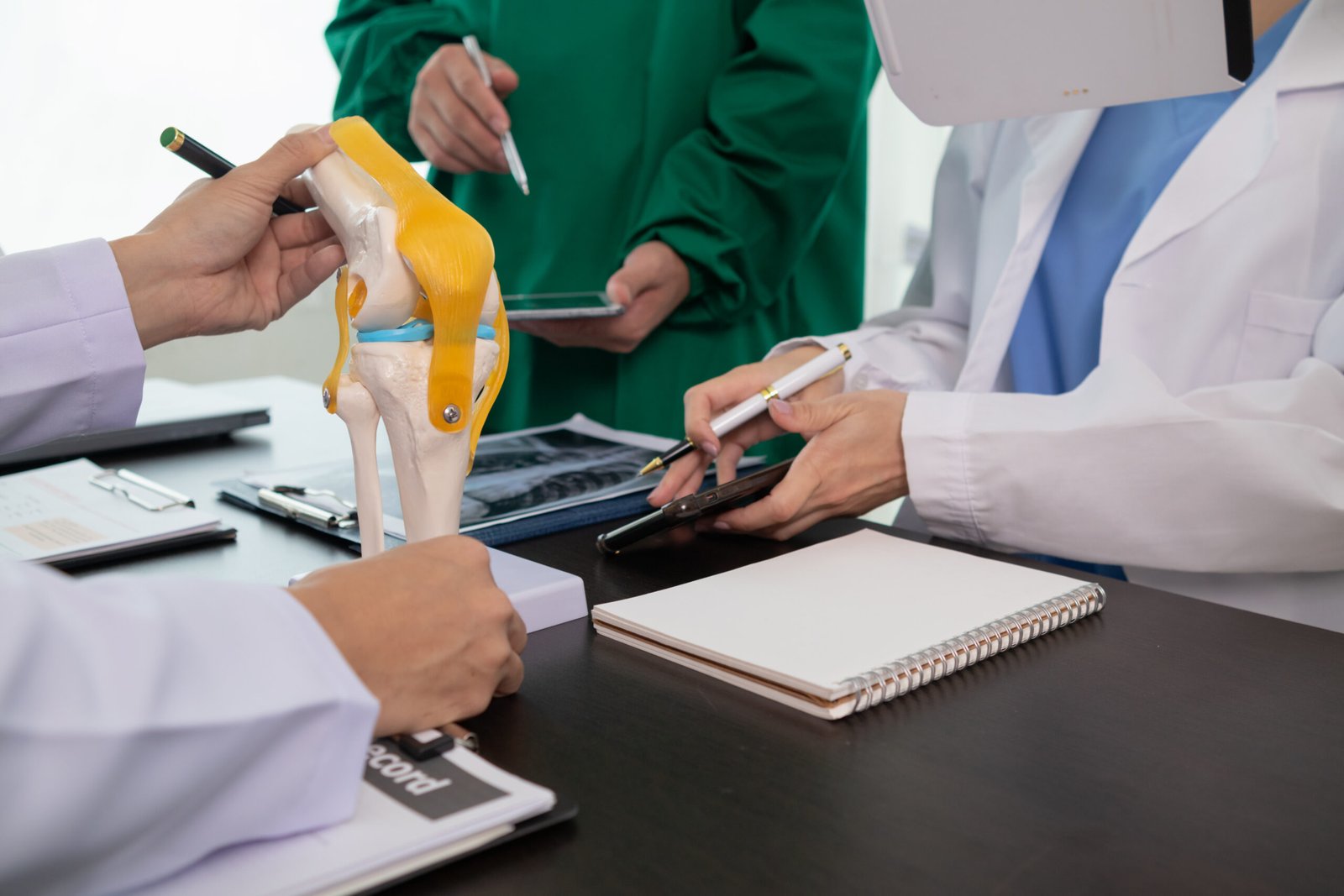
Prof. Thanainit’s view reflects what he sees in clinic every day. Patients are living longer, and many of them are older but still physically fit. They want to keep moving, travelling and playing sport. As they age, osteoarthritis catches up with them, and that combination of longer lives and active lifestyles is why more patients are reaching the point of surgery.
In other words, a good candidate is not defined by age alone. It is someone whose knee is holding them back from the life they still want to live. Points worth discussing with any surgeon include:
- How much your knee pain limits walking, stairs, sleep and daily activities
- What non-surgical treatment you have already tried, and for how long
- What your X-rays or scans show about the severity of the arthritis
- Your general health, weight and any conditions that affect anaesthesia or healing
- What you want to get back to, whether that is golf, grandchildren or simply walking the dog
If you are weighing up treatment abroad, our knee replacement in Thailand page explains how the process works for international patients, from sending your X-rays to flying home.
From Protecting Your Own Joint to Robotic Surgery
One of the most reassuring parts of the interview was hearing that surgery is not the first answer. “For osteoarthritis, we have a lot of research,” Prof. Thanainit said. “When the patient has mild, not severe osteoarthritis, we study their activity, and we like to stop the arthritis, to let the patient use their own joint for longer.”
Only when the arthritis becomes severe does he move to surgery, and his department offers what he called the full range of options for osteoarthritis. In his words: “We start from arthroscopic surgery, high tibial osteotomy, total knee surgery, robotic surgery.”
Here is how that ladder of treatment looks, roughly in order from least to most invasive:
- Non-surgical management for mild arthritis, focused on activity, strengthening and slowing progression.
- Arthroscopic surgery, a keyhole procedure. Our guide to arthroscopic knee surgery in Bangkok covers what it can and cannot fix.
- High tibial osteotomy, which realigns the shin bone to shift load away from the worn part of the knee and preserve the natural joint.
- Total knee replacement, where the damaged joint surfaces are replaced with an implant.
- Robotic-assisted knee replacement, where a robotic system helps the surgeon plan and position the implant.
| Option | What it involves | Main aim |
|---|---|---|
| Non-surgical care | Activity changes, exercise, monitoring | Slow the arthritis and keep your own joint |
| Arthroscopy | Keyhole surgery through small incisions | Treat specific problems inside the joint |
| High tibial osteotomy | Realigning the shin bone | Take pressure off the damaged area |
| Total knee replacement | Replacing joint surfaces with an implant | Relieve pain and restore movement |
| Robotic-assisted replacement | Implant planned and positioned with robotic guidance | Precise implant placement |
If you are unsure which of the last two suits you, our comparison of robotic and conventional knee replacement walks through the differences.
Anaesthesia, Pain Control and the First 48 Hours
For many patients, the fear is not the operation itself but the pain afterwards. Prof. Thanainit said patient priorities have shifted: “Now patients are more concerned about early movement and no pain.”
His approach for knee replacement centres on a pain-control catheter placed at the time of surgery. “We use a catheter at the time of surgery to control the pain, so they have no pain after surgery,” he explained. “When the patient needs more exercise, we remove it 48 hours after surgery. At that time, the pain is less.”
He then listed what his patients usually avoid:
- No urinary catheter after surgery
- No blood transfusion in routine cases
- No surgical drain from the wound
The length of the operation and the exact anaesthetic plan depend on your health and the type of replacement, so ask for these to be confirmed at your consultation. What came through clearly is that early, comfortable movement is the goal from day one.
How Long Will You Stay in Hospital?
Prof. Thanainit described two pathways at Phyathai 2. Patients who want it can have one-day surgery: the operation is done in the morning and the patient goes home the same day. Because some patients need more physiotherapy before leaving, the hospital also offers a stay of two or three days after surgery.
For international patients, we plan around the longer pathway, because you are recovering far from home and need physiotherapy and a follow-up check before you fly.
| Same-day pathway | International patient pathway (Medidash) | |
|---|---|---|
| Who it suits | Suitable patients who prefer to go home the same day | Patients travelling from overseas |
| Hospital stay | Home the same day | 3 to 4 nights in hospital |
| Physiotherapy | Continued as an outpatient | In-hospital physio, then recovery in Bangkok |
| Total time in Thailand | Not applicable | 2 to 3 weeks minimum, including 10 to 14 days before flying |
The 10 to 14 days of recovery before flying is there for a reason. Our guide on when it is safe to fly after knee replacement explains the clot risk and what your surgeon will check before clearing you to travel.
What Makes Phyathai 2’s Orthopaedic Department Stand Out?
We asked Prof. Thanainit what sets his department apart. His answer was about volume. “When you consider private hospitals, we are number one,” he said. “The total number of visits per year is about 50,000, for orthopaedics only. The number of visits here is very similar to a university hospital. It means Thai people are very attached to orthopaedics here at Phyathai 2.”
That figure is the hospital’s own, but the outside credentials back up the picture of a well-run institution:
- Joint Commission International (JCI) accreditation, the international benchmark for hospital safety and quality
- Advanced Hospital Accreditation from Thailand’s Hospital Accreditation Institute, valid from January 2026 to January 2030, according to the HA Thailand certificate register
- Medical Tourism Hospital of the Year (Thailand) at the Healthcare Asia Awards 2026, as reported by The Thaiger
Phyathai 2 is one of the hospitals we compare in our roundup of the best hospitals in Thailand for knee replacement, if you would like to see how it sits alongside the alternatives.
Why This Matters If You Are Waiting at Home
Many of the patients we help are not looking for a cheaper option first. They are tired of waiting while their knees get worse. In Australia, for example, the latest national data shows that orthopaedic surgery has one of the longest tails of any specialty: 11% of orthopaedic patients waited more than 365 days to be admitted for public elective surgery in 2024 to 2025, according to the Australian Institute of Health and Welfare.
In Bangkok, surgery can usually be scheduled within 2 to 4 weeks of your X-rays being reviewed. Speed only counts if the quality is there too, which is exactly why we interview the surgeons we work with rather than simply listing hospitals.
Would you like Prof. Thanainit to review your X-rays? Send them to our team on WhatsApp at +66 92 390 8624 and we will arrange an initial assessment.
Questions to Ask Any Knee Replacement Surgeon
Whether you choose Prof. Thanainit or another surgeon, these are the questions we encourage every patient to ask before booking:
- How many knee replacements do you perform each year?
- Which implant will you use, and why is it right for my knee?
- Would a partial replacement, osteotomy or robotic surgery suit me better?
- How will my pain be managed in the first 48 hours?
- How soon will I be walking, and how much physiotherapy is included?
- When will it be safe for me to fly home?
- Who do I contact if I have a problem after I return home?
A good surgeon will welcome these questions. Prof. Thanainit answered every one of ours without hesitation.
Speak to Medidash About Treatment with Prof. Thanainit
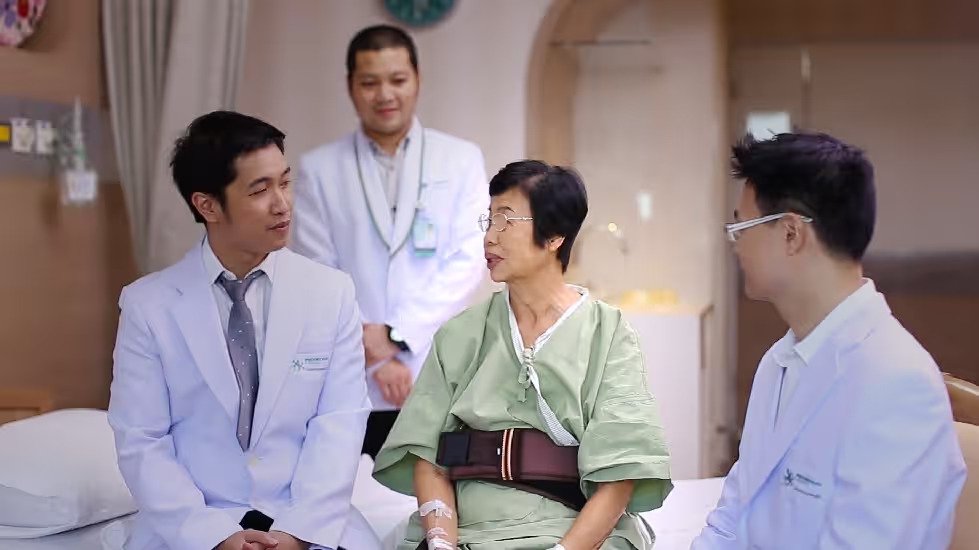
If your knee or hip is stopping you from living the way you want, a consultation with an experienced arthroplasty surgeon is the right first step. Medidash Global can share your X-rays with Prof. Thanainit, arrange your consultation at Phyathai 2, and look after your airport pickup, hospital coordination and recovery stay in Bangkok. Our founder, Alex, personally accompanies patients from arrival to their hospital appointments. If it is your hip rather than your knee, Prof. Thanainit is equally specialised in hip replacement surgery in Bangkok.
Get in touch with our patient team, message us on WhatsApp at +66 92 390 8624, or email aw.medidash@gmail.com. There is no obligation, and we will answer your questions honestly, including whether surgery abroad is right for you.
Frequently Asked Questions about Knee Replacement Surgeons in Thailand
Who is Prof. Dr. Thanainit Chotanaphuti?
He is a hip and knee replacement specialist at Phyathai 2 International Hospital in Bangkok, with around 30 years of experience and about 15,000 joint replacement procedures. He has served as President of the Thai Hip & Knee Society and the ASEAN Arthroplasty Association.
Does Prof. Thanainit perform robotic knee replacement?
Robotic surgery is one of the options he offers. He told us his team covers the full range of treatment for knee osteoarthritis, from arthroscopic surgery and high tibial osteotomy through to total knee replacement and robotic surgery. He has also served as President of the Asia-Pacific society for computer-assisted orthopaedic surgery.
How long will I stay in hospital after knee replacement at Phyathai 2?
Phyathai 2 offers same-day surgery for suitable local patients and a stay of two to three days after surgery for those who need more physiotherapy. Medidash’s international package includes 3 to 4 nights in hospital, with 10 to 14 days of recovery in Bangkok before flying home.
Will I need a blood transfusion or a drain after surgery?
According to Prof. Thanainit, his routine knee replacement patients do not usually need a blood transfusion, a urinary catheter or a wound drain. Your own plan will depend on your health, so confirm it at your consultation.
Is Phyathai 2 International Hospital accredited?
Yes. Phyathai 2 holds Joint Commission International (JCI) accreditation and Advanced Hospital Accreditation from Thailand’s Hospital Accreditation Institute, valid until January 2030.
Can I talk to Prof. Thanainit before travelling to Bangkok?
Yes. Medidash can send your X-rays and medical history to Prof. Thanainit for review before you commit to travel, so you know whether surgery is recommended and what type.
About Prof. Dr. Thanainit Chotanaphuti
Orthopaedic Surgeon, Hip and Knee Specialist
Orthopaedic Institute, Phyathai 2 International Hospital, Bangkok
Education and Training
| Year | Qualification | Institution |
|---|---|---|
| 1985 | Doctor of Medicine | Faculty of Medicine Siriraj Hospital, Mahidol University, Thailand |
| 1991 | Diploma of the Thai Board of Orthopaedic Surgery | The Medical Council of Thailand |
| 1992 | Orthopaedic Fellowship | Niigata University, Japan |
| 1993 | AO Basic Course | Davos, Switzerland |
| 1994 | Arthroscopy Training | Syracuse University, USA |
| 1995 | Ilizarov Course | Lecco, Italy |
Leadership and Memberships
Prof. Thanainit has served as:
- President, ASEAN Arthroplasty Association
- President, Royal College of Orthopaedic Surgeons of Thailand
- President, Asia-Pacific Computer Assisted Orthopaedic Surgery
- President, Thai Hip & Knee Society
- President, Asia-Pacific Organization of Knee Arthroplasty
Professional Experience
| Period | Role |
|---|---|
| 2023 to present | Orthopaedic Surgeon, Phyathai 2 International Hospital, Bangkok |
| 1996 to present | Orthopaedic Surgeon, Department of Orthopaedics, Phramongkutklao Hospital, Bangkok |
| 1996 to 2002 | Assistant Professor, Department of Orthopaedics, Phramongkutklao College of Medicine, Bangkok |
| 1991 to 1992 | Orthopaedic Surgeon, Anantamahidol Hospital, Lopburi |
| 1988 to 1991 | Orthopaedic Resident, Phramongkutklao Hospital, Bangkok |
| 1985 to 1988 | General Practitioner, Vachiravuj Hospital, Nakhon Si Thammarat |
Area of Expertise
Hip and knee surgery
Clinic Hours
| Day | Time | Location |
|---|---|---|
| Monday | 10:00 to 15:00 | Orthopaedic Institute, 5th floor, Building B |
| Tuesday | 13:00 to 17:00 | Orthopaedic Institute, 5th floor, Building B |