
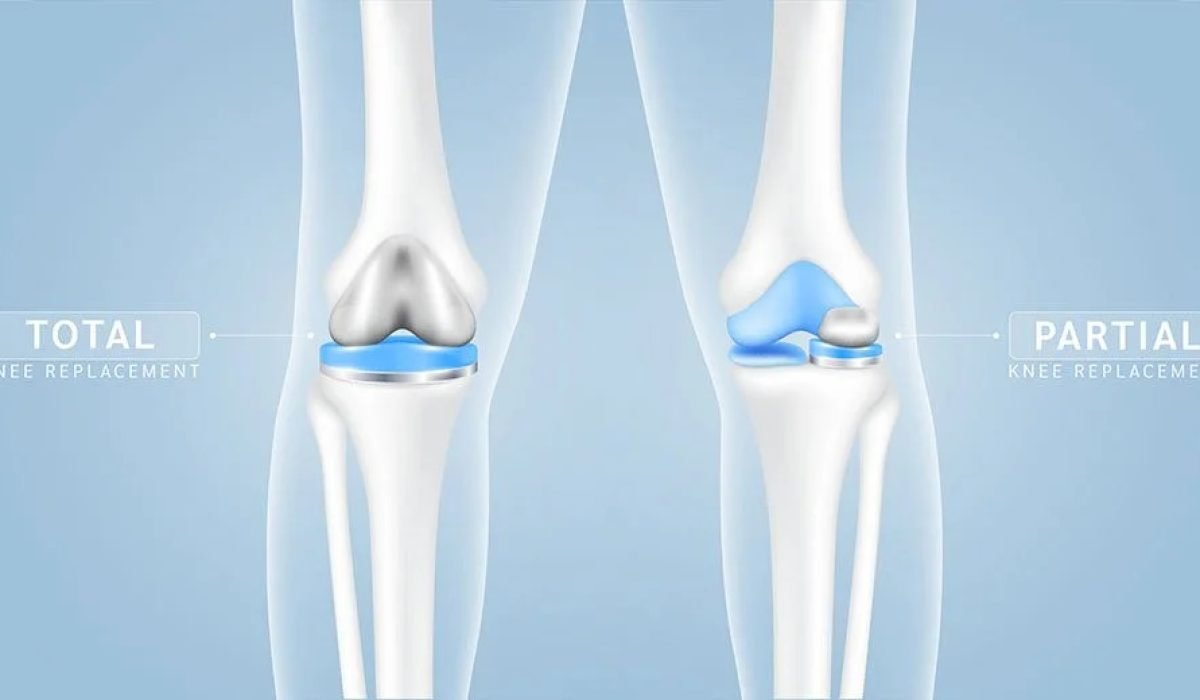
If your knee X-ray shows arthritis on only one side of the joint, your surgeon may have mentioned a partial knee replacement instead of a full knee replacement. Both procedures treat the same underlying problem, worn-out cartilage causing pain and stiffness, but they are not interchangeable. Choosing the wrong one can mean a longer recovery than necessary or, in some cases, a second surgery down the track. A partial knee replacement, also called a unicompartmental knee replacement or informally a “half knee replacement,” resurfaces only the damaged section of the joint. A total knee replacement resurfaces the whole joint. This guide walks through how surgeons decide between them, what recovery looks like for each, and what to ask before you commit to either procedure.
It is one of the more common questions patients ask before scheduling knee replacement in Thailand with Medidash Global. Getting the answer right starts with understanding what each procedure actually does inside the joint.
What Is a Partial Knee Replacement?
The knee joint has three main compartments: the medial (inner) compartment, the lateral (outer) compartment, and the patellofemoral compartment behind the kneecap. Osteoarthritis often starts in just one of these areas, most commonly the medial compartment.
A partial knee replacement, or unicompartmental knee replacement, resurfaces only the damaged compartment. The surgeon removes the worn cartilage and a thin layer of bone from that section alone, then fits a smaller implant in its place. Because the rest of the joint, including the anterior cruciate ligament (ACL) and posterior cruciate ligament (PCL), is left untouched, many patients describe the resulting knee as feeling closer to a natural joint than after a full replacement.
For a fuller breakdown of the anatomical terms surgeons use during assessment, see our knee surgery terminology guide.
What Is a Total Knee Replacement?
A total knee replacement, or total knee arthroplasty, resurfaces all three compartments of the joint. The surgeon removes damaged cartilage and bone from the end of the femur, the top of the tibia, and often the underside of the kneecap, then replaces these surfaces with metal and high-grade plastic components. The ACL is almost always removed during this procedure, and the PCL may be retained or replaced depending on the implant design and the surgeon’s technique.
Total knee replacement is the more established and more commonly performed of the two procedures, whether performed locally or as total knee replacement in Thailand. It suits patients whose arthritis or joint damage has spread across the whole knee, rather than staying confined to one compartment.
Total vs Partial Knee Replacement: How They Compare
The table below summarises the practical differences between the two procedures. Individual results vary, and your surgeon’s assessment of your imaging and ligament health is what ultimately determines which option applies to you.
| Factor | Partial Knee Replacement | Total Knee Replacement |
| Compartments treated | One (medial, lateral, or patellofemoral) | All three compartments |
| Ligaments (ACL / PCL) | Usually preserved | ACL usually removed |
| Bone removed | Minimal | More extensive |
| Typical hospital stay | 1 to 2 days | 2 to 4 days |
| Walking with support | Same day or within 1 to 2 days | Usually within 24 hours |
| Initial recovery | 3 to 6 weeks | 6 to 12 weeks |
| Return to full activity | Around 3 to 4 months | 3 to 6 months, sometimes longer |
| Typical implant lifespan | 10 to 20 years, varies by activity | 15 to 20 years or more |
| Revision likelihood | Somewhat higher | Lower |
Research comparing outcomes between the two procedures has found partial knee replacement is generally associated with a faster recovery and fewer medical complications, while total knee replacement carries a lower long-term revision rate. Both are considered standard, well-established treatments for knee osteoarthritis.
Am I a Candidate for Partial Knee Replacement?
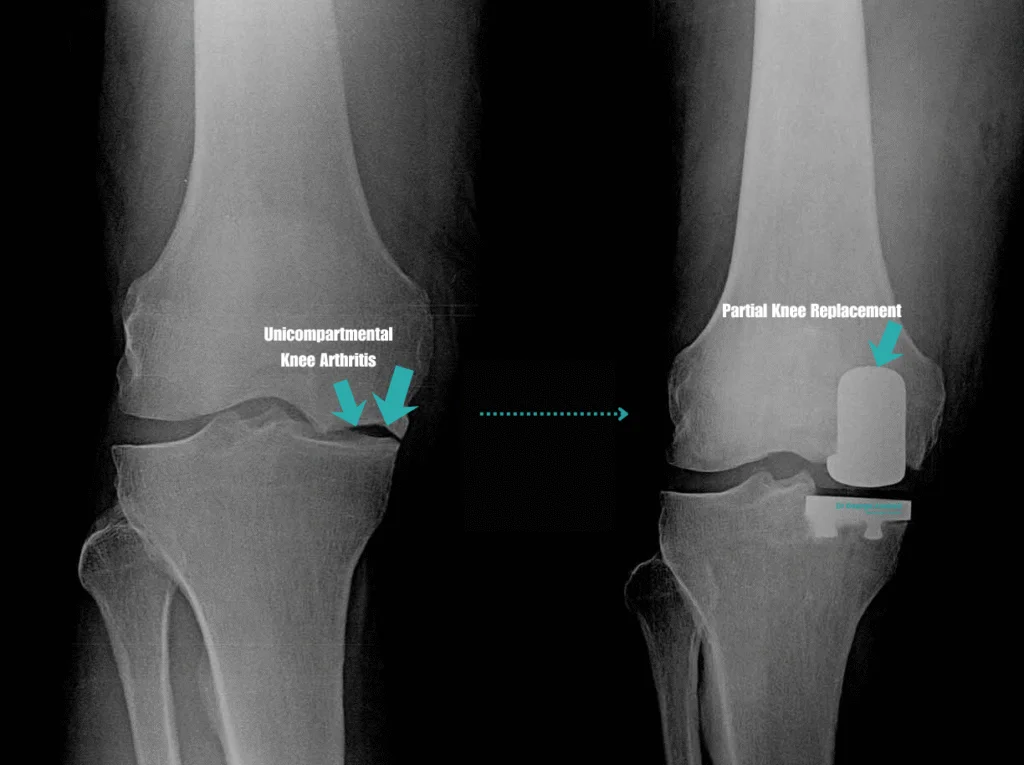
Not every patient with one-sided knee pain qualifies for a partial replacement, and not every surgeon offers it. Suitability depends on where the damage is located, how much of it there is, and the condition of the surrounding ligaments.
Signs Partial Knee Replacement May Suit You
- Pain and stiffness concentrated on one side of the knee, confirmed by X-ray or MRI
- Arthritis limited to a single compartment, with the rest of the cartilage still healthy
- An intact, functioning ACL
- No significant knee deformity or major misalignment
- A body weight and activity level your surgeon considers suitable for a smaller implant
When Total Knee Replacement Is the Better Choice
- Arthritis or damage affecting two or more compartments
- Rheumatoid arthritis or another inflammatory joint condition
- A torn or missing ACL
- Significant knee deformity, such as severe bowing or knock-knee
- Previous knee surgery that has altered the joint’s structure
Up to half of all patients being assessed for knee replacement surgery may be eligible for the partial procedure, yet in the UK only around 8 percent currently receive one, according to published research on shared decision-making for knee replacement. A second opinion is worth seeking if a partial procedure hasn’t been raised with you.
Recovery Timeline: Partial vs Total Knee Replacement
Recovery follows a broadly similar pattern for both procedures, just compressed into a shorter timeframe for partial knee replacement:
- Day of surgery to day 2: most patients begin walking with a frame or crutches, supported by hospital physiotherapy staff.
- Week 1 to 3: pain and swelling reduce, and physiotherapy exercises begin rebuilding range of motion.
- Week 3 to 6: patients typically move from crutches to a cane; partial knee replacement patients often return to light daily activities in this window.
- Week 6 to 12: total knee replacement patients continue building strength and range of motion, with many returning to driving and light work.
- Month 3 to 6: most patients reach or approach their expected level of function, though full total knee replacement recovery sometimes extends toward the 12-month mark for muscle strength to fully return.
Robotic-Assisted Partial Knee Replacement: Why Precision Matters
Partial knee replacement asks more of surgical precision than a total replacement, because a smaller implant has to sit exactly right within a joint that still relies on its natural ligaments for stability. This is where robotic-assisted systems such as MAKO have become widely used.
Before surgery, a CT scan builds a 3D model of the patient’s knee, which the surgeon uses to plan implant size, position, and alignment. During surgery, the robotic arm keeps the surgeon’s movements within that plan. A recent meta-analysis comparing robotic-assisted and manual unicompartmental knee replacement found the robotic approach produced measurably more accurate component alignment, with fewer patients falling outside the target range.
Medidash Global’s partner hospitals in Bangkok offer robotic-assisted options for both partial and total knee replacement. You can read more about how MAKO robotic surgery works before your consultation.
How Long Would You Wait at Home, and What Does It Cost Abroad?
For patients relying on public health systems, waiting for either procedure can take a long time. In Australia, the median public hospital wait for a total knee replacement was 265 days in 2023 to 2024, according to national data collected by the Australian Institute of Health and Welfare. Partial knee replacement isn’t tracked separately in most public waiting-list data, but patients typically face similar delays, since both procedures compete for the same orthopaedic surgery lists.
Private surgery shortens that wait considerably, though often at a cost that puts it out of reach without extensive insurance cover or a large out-of-pocket payment.
Treatment at a JCI-accredited hospital in Bangkok is a route more international patients are exploring for both partial and total knee replacement, with surgery typically scheduled within a few weeks of an initial consultation rather than many months. Because a partial knee replacement uses a smaller implant and involves less surgical time, it is also usually priced lower than a total knee replacement, though your surgeon will only recommend it if it is clinically appropriate for your joint. If you would like an idea of current pricing for your situation, get a personalised quote from our patient care team.
How Medidash Global Supports Your Knee Replacement Journey

Deciding between a partial and total knee replacement is a clinical decision made with your orthopaedic surgeon, based on your imaging, your ligament health, and your goals for activity afterward. Medidash Global’s role starts once that decision is close: coordinating your consultation with a JCI-accredited hospital in Bangkok, confirming which procedure and implant type your case calls for, and arranging the practical side of treating a joint replacement abroad, including visa guidance, travel and hotel arrangements, and an interpreter for hospital appointments where needed.
After surgery, most patients spend a few days in hospital, depending on which procedure they’ve had, followed by a period of local physiotherapy before flying home. If you’re planning the trip around a partial or total knee replacement, our guide to flying home after knee replacement covers what to expect from your surgical team about timing. For a wider look at both procedures side by side, our complete guide to knee and hip replacement covers additional recovery and preparation detail.
Whichever procedure your surgeon recommends, the most reliable path to a good outcome is an accurate diagnosis, an experienced surgical team, and a recovery plan you can actually follow, whether that’s at home or abroad. If you’re weighing up a partial or total knee replacement and want to understand your options at a JCI-accredited hospital in Bangkok, speak with our patient care team to arrange a consultation.
Frequently Asked Questions About Partial Knee Replacement
Is partial knee replacement less painful than total knee replacement?
Most patients report less post-operative pain after partial knee replacement, largely because less bone and tissue is disturbed during surgery. Pain levels still vary by individual, and both procedures are typically well managed with modern pain control protocols.
How do I know which compartment of my knee is damaged?
An X-ray and, in many cases, an MRI will show your surgeon exactly where cartilage has worn away. This imaging, combined with a physical exam of your ligaments and alignment, is what determines whether you’re a candidate for a partial or total procedure.
Can a partial knee replacement be converted to a total knee replacement later?
Yes. If arthritis progresses in another compartment of the knee, a partial knee replacement can usually be revised to a total knee replacement in a later surgery. This is one reason surgeons weigh long-term joint health, not just current symptoms, when recommending a procedure.
Which lasts longer, partial or total knee replacement?
Total knee replacement implants generally have a lower revision rate over the long term, though both types commonly last 10 to 20 years or more depending on activity level and weight.
Is partial knee replacement cheaper than total knee replacement?
It’s often priced lower because it uses a smaller implant and typically involves a shorter procedure and hospital stay, though the exact cost depends on the hospital, the implant used, and whether robotic-assisted technology is involved.
Can I have robotic-assisted knee replacement in Thailand?
Yes. Medidash Global’s partner hospitals in Bangkok offer robotic-assisted options for both partial and total knee replacement, alongside conventional techniques, depending on what your surgeon recommends for your knee.