

Hip replacement is one of the most consistently successful operations in modern medicine, and one of the most difficult to access on fair terms in the UK. For most patients, the question is not whether they need the operation. It is the question of which route to take to get there, and what it is going to cost them.
Hip replacement cost in the UK varies dramatically depending on whether you go through the NHS, choose a UK private hospital, or pursue treatment abroad through an internationally accredited provider. Each route carries a very different price, a very different wait, and a very different patient experience.
This guide gives you the current figures across all three routes so you can compare them honestly and decide what makes sense for your situation.
Hip Replacement Cost in the UK at a Glance
This table is the fastest way to see how your three main options compare. The full details follow below.
| Option | Typical Cost | Waiting Time | What’s Included |
| NHS | Free | 27+ weeks average | Surgery, hospital stay, initial physiotherapy |
| UK Private (Spire / Nuffield / Circle) | £11,000 – £18,000+ | 2–4 weeks | Surgery, implant, hospital stay, initial physio |
| Thailand via Medidash | From £8,500* | 2–4 weeks | Surgery, hospital stay, physiotherapy, airport transfers, and aftercare coordination |
| MAKO Robotic Hip (Thailand) | From £17,000 | 2–4 weeks | All-inclusive robotic surgery package |
All pricing is provided as a guide only and may vary based on individual patient requirements.
How Much Does an NHS Hip Replacement Cost?
For UK residents, an NHS hip replacement is free at the point of use. You pay nothing for the surgery, the hospital stay, the implant, or your initial physiotherapy. The cost, for most patients, is measured not in money but in time.
According to a parliamentary written answer published in February 2025, there are currently 31,323 patients on the NHS waiting list for hip replacement surgery in England. The average waiting time is 27.4 weeks, the better part of seven months from referral to the operating table.
What makes this harder to accept is that NHS performance remains well below its own constitutional standard. The NHS constitution requires that 92% of patients begin elective treatment within 18 weeks of referral. According to data from the King’s Fund, only around 62% of patients were meeting that threshold as of late 2025. The standard has not been achieved nationally since September 2015.
For hip replacement patients specifically, this gap is painful in the most literal sense. Joint deterioration does not pause while you wait for a surgery slot. Pain typically worsens over months. Mobility declines. Dependency on analgesics becomes routine. A wait that sounds manageable on paper can be a significant period of reduced quality of life for someone struggling with daily movement.
There are options within the NHS worth exploring. Under the Patient Choice framework, you can ask your General Practitioner (GP) to refer you to a different NHS trust if your local hospital has a longer waiting list. Some patients gain a few weeks through this route. Your GP can also check whether local independent sector providers have been commissioned by the NHS in your area, which occasionally opens faster slots. More information is available on NHS.uk. The reality, however, is that improvements through these routes are rarely transformative when demand is this high across the whole system.
How Much Does a Private Hip Replacement Cost in the UK?
Private hip replacement surgery removes the waiting time almost entirely. Most patients can be treated within two to four weeks of their first consultation. The trade-off is a high upfront cost that not everyone can absorb.
Based on self-pay guide prices published by major UK providers in 2025 and 2026, here is what a standard total hip replacement typically costs:
| Provider | Typical Self-Pay Cost |
| Practice Plus Group | From approximately £12,500 – £13,200 |
| Circle Health Group | Approximately £11,000 – £14,000 |
| Spire Healthcare | £13,000 – £17,000 (varies by location) |
| Nuffield Health | £13,000 – £17,000 (varies by location) |
| HCA Healthcare (London) | £15,000 – £19,000+ |
London hospitals sit consistently at the upper end of these ranges. A hip replacement at a central London facility can cost £3,000 to £5,000 more than the same procedure at an equivalent hospital in the Midlands, North West, or Scotland.
What is typically included in a UK private hip replacement?
- Pre-operative assessment and diagnostic tests
- Surgeon and anaesthetist fees
- Theatre time
- The hip implant
- Two to three nights in the hospital
- An initial post-operative physiotherapy session
What is typically not included?
- Ongoing outpatient physiotherapy after discharge
- Follow-up consultant appointments beyond an initial review
- Any complications requiring additional treatment
- Travel or accommodation if your chosen hospital is not local to you
If you hold comprehensive private medical insurance through Bupa, AXA Health, or Vitality, your insurer may cover the full cost, subject to your policy excess and pre-authorisation. The critical caveat: most policies exclude pre-existing conditions. If you were already experiencing hip problems before your policy start date, cover is unlikely to apply. Always request pre-authorisation from your insurer before committing to any provider, and check your policy documents carefully.
For patients without insurance who cannot justify £13,000 to £18,000 out of pocket, there is a third route worth examining seriously.
How Much Does a Hip Replacement Cost in Thailand?
Thailand is one of the most established medical tourism destinations in the world for orthopaedic surgery, and cost is a major reason patients research joint replacement in Thailand as an alternative to the UK routes above. Bangkok’s leading hospitals hold Joint Commission International (JCI) accreditation, the same international quality standard that governs the best private hospitals across Europe and the United States. Surgical volumes in these hospitals are high, and that matters. Hip and knee replacement surgeons in Bangkok’s top facilities often operate at a volume that matches or exceeds many UK private consultants.
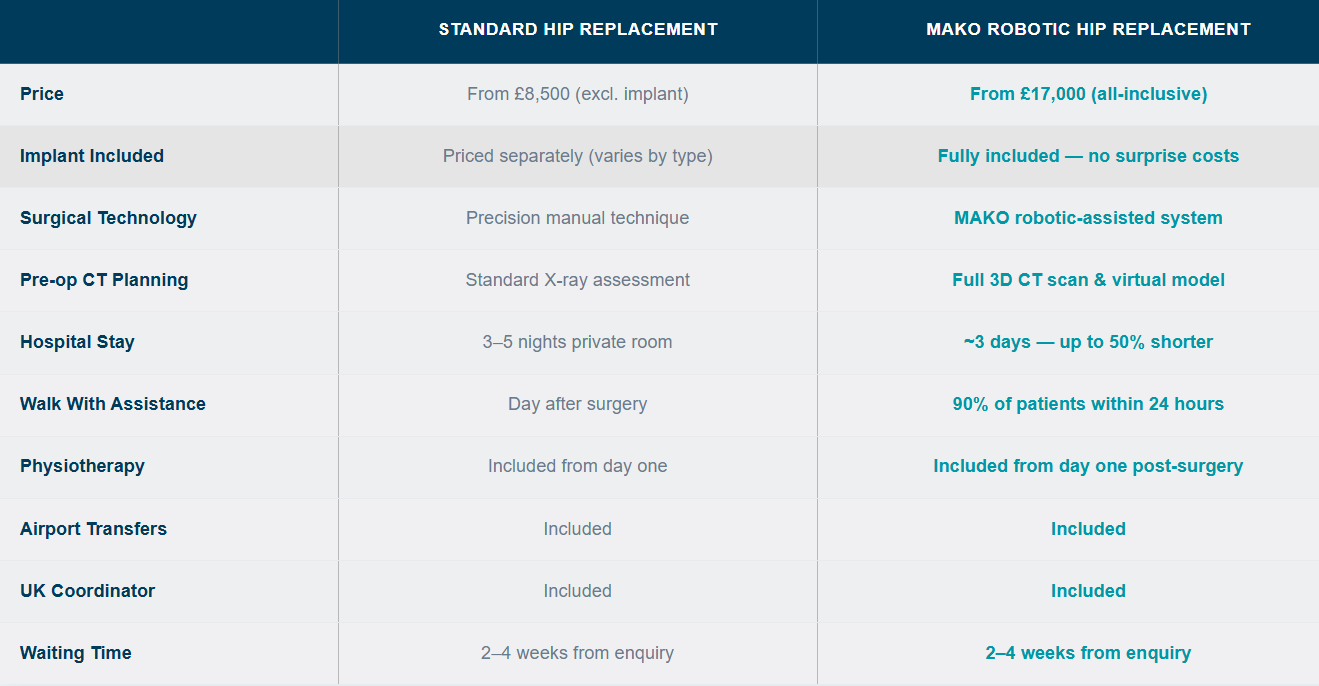
Through Medidash Global, UK patients can access standard hip replacement surgery in Bangkok from £8,500. This includes surgery, your hospital stay, physiotherapy during your recovery period in Thailand, airport transfers, and full aftercare coordination before, during, and after your trip.
For patients interested in robotic-assisted surgery, MAKO robotic hip replacement is available from £17,000 as an all-inclusive package. This uses pre-operative CT imaging and real-time robotic guidance to position the implant with a level of precision that is difficult to achieve through manual technique alone. For context, MAKO procedures at UK private hospitals carry a comparable price and do not necessarily include the same scope of care coordination or post-discharge support.
Factoring in Travel Costs
Any honest comparison between Thailand and the UK private care needs to include travel. Here is a realistic estimate for one patient travelling from the UK:
- Return flights from a UK airport to Bangkok: approximately £600 – £1,000
- Accommodation for a two-week stay (comfortable hotel or serviced apartment): approximately £600 – £1,200
- Estimated total additional travel cost: £1,200 – £2,200
Even with travel and accommodation included, the total out-of-pocket cost of a standard hip replacement via Medidash is typically lower than an equivalent UK private package for the majority of patients outside London. The waiting time is comparable with UK private care. And for JCI-accredited hospitals, the quality standard is internationally benchmarked.
One point worth being transparent about: ongoing physiotherapy and follow-up care after you return to the UK is your responsibility to arrange locally. Medidash provides a detailed medical report for your GP and aftercare coordination support, but long-term rehabilitation at home is managed through your own GP or a local private physiotherapist.
What Affects the Cost of a Hip Replacement?
Understanding the main cost variables allows you to compare quotes accurately, whether you are looking at UK providers or treatment abroad.
Implant Type
The hip implant itself is a significant component of the total cost. The main types are ceramic-on-ceramic, ceramic-on-polyethylene, and metal-on-polyethylene. Ceramic implants carry a higher upfront cost but are associated with greater durability and lower wear rates over time. Your surgeon will recommend the appropriate implant based on your age, activity level, body weight, and bone condition.
Surgical Technique
Standard hip replacement uses a conventional surgical approach. Minimally invasive techniques use smaller incisions and may reduce soft tissue disruption, potentially shortening recovery. MAKO robotic-assisted surgery uses a pre-operative CT scan and robotic arm guidance to place the implant with greater precision. Each step up in technique adds cost, and the clinical benefit of each should be discussed with your surgeon before committing.
Unilateral or Bilateral
If both hips require replacement, having them done in a single surgical episode (bilateral replacement) can reduce the overall cost compared to two separate procedures. However, bilateral surgery carries a greater anaesthetic load and a longer initial recovery. This is a clinical decision to make with your orthopaedic surgeon based on your overall health and fitness for surgery, not a decision driven by cost alone.
Hospital Location
In the UK, London adds a significant premium. The same procedure at an equivalent standard can cost £3,000 to £5,000 less outside the capital. In Bangkok, hospital infrastructure costs are substantially lower than comparable facilities in Western Europe, which is the primary reason overseas pricing remains competitive even after travel costs are factored in.

Ready to Explore Your Options for Hip Replacement
Hip replacement surgery does not have to mean months of waiting in pain, or a bill of £15,000 or more. For patients who cannot face the NHS queue and cannot justify the full cost of UK private care, Bangkok’s top orthopaedic hospitals accessed through Medidash Global offer a genuinely competitive alternative.
The hospitals are internationally accredited. The surgical teams are experienced in treating international patients. And the end-to-end patient pathway, from your initial enquiry through to aftercare coordination when you return home, is managed by a team that understands every stage of the journey.
The next step is straightforward. Contact Medidash for a free, no-obligation quote. You will receive a personalised cost breakdown covering your specific procedure, recommended hospital, full cost summary, and travel itinerary, at no cost and no commitment.
Frequently Asked Questions About Hip Replacement Cost
Is hip replacement cheaper abroad?
Yes, in most cases. A standard hip replacement in Thailand through an accredited provider such as Medidash typically costs less than the equivalent UK private procedure, even after flights and accommodation are factored in. The key is choosing a JCI-accredited hospital and a provider with a structured UK patient pathway.
Does Bupa cover hip replacement?
Most comprehensive Bupa plans include joint replacement for conditions that arise after the policy start date. You would typically pay your chosen policy excess, with Bupa covering the rest, subject to pre-authorisation. If your hip condition predates your policy, the claim will almost certainly be excluded as a pre-existing condition. Contact Bupa directly and request pre-authorisation before making any decisions.
What is the cheapest way to get a hip replacement?
The NHS is free but carries an average wait of over 27 weeks, with many patients waiting considerably longer in certain regions. For those who need faster access, Thailand offers the best combination of cost and speed for self-paying patients. Medidash packages are typically priced below UK private care, with JCI-accredited hospital standards.
Can I get a hip replacement on the NHS faster?
You can ask your GP to refer you to a different NHS trust with a shorter waiting list under the Patient Choice framework. Some patients save a few weeks this way. For a meaningful reduction in waiting time, UK private care or treatment abroad are the only reliably faster option.
How soon can I fly home after hip replacement?
Most patients can travel by air within seven to fourteen days of surgery, subject to sign-off from your surgical team. The specifics depend on flight length, your recovery progress, and your overall health.
How much is hip replacement surgery in the UK privately?
UK private hip replacement surgery costs between £11,000 and £18,000+, depending on provider, location, implant type, and what is included in the package. London hospitals are typically at the upper end of this range. Always confirm current pricing directly with your chosen provider, as costs vary by hospital and consultant.
Further Reading: