
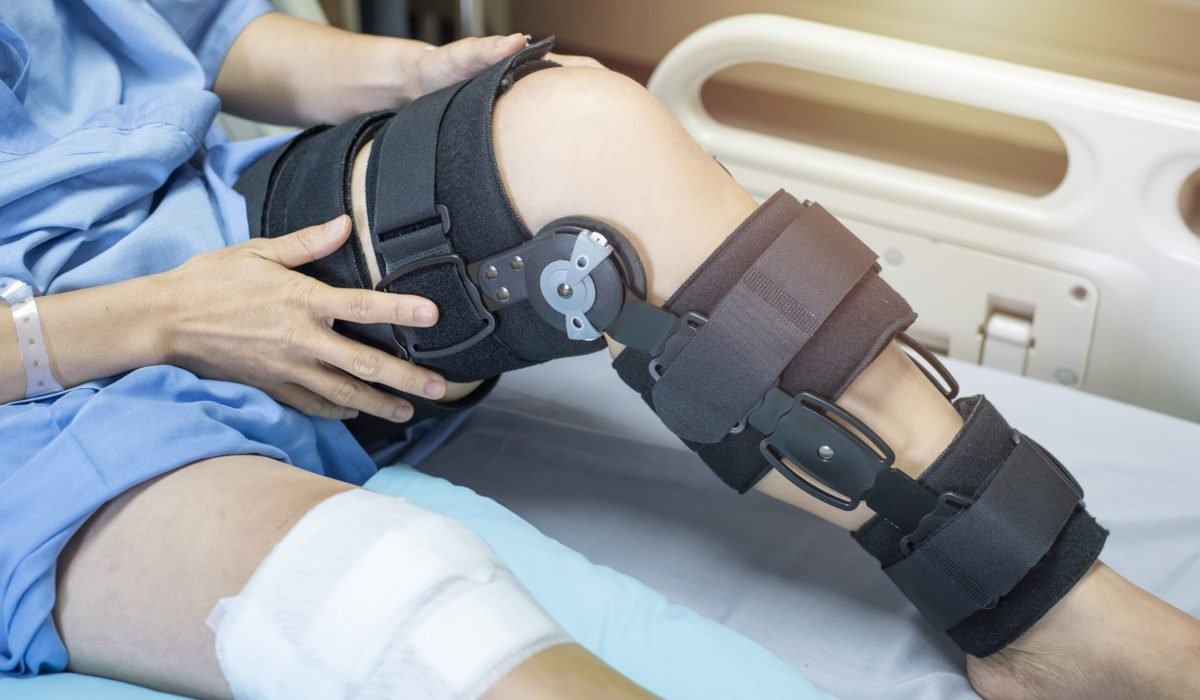
Choosing between robotic knee replacement and conventional knee replacement surgery is one of the first big decisions patients face when planning joint replacement abroad. Both approaches replace a worn or damaged knee joint with an artificial one, but they differ in how the surgeon plans and carries out the procedure. Robotic knee replacement uses a computer-guided arm to help position the implant with sub-millimetre accuracy, while conventional knee replacement relies on manual cutting guides and the surgeon’s direct judgement. Neither technique is automatically the right answer for every patient. This guide compares how each approach works, what the current evidence says about outcomes, and what robotic knee replacement typically costs in Bangkok against the waiting times and private fees many Australian patients face at home.
What Is Robotic Knee Replacement?
Robotic knee replacement, often called MAKO robotic knee replacement after the most widely used surgical platform, starts before the patient ever enters the operating theatre. A CT scan of the knee is used to build a 3D model of the joint, and the surgeon uses that model to plan the implant’s size, position and angle in advance. During surgery, the surgeon still makes every cut and places the implant; the robotic arm acts as a guide, staying inside the pre-planned boundary and alerting the surgeon if an instrument drifts outside it. For patients researching robotic knee replacement in Thailand, this technology is increasingly available at hospitals equipped with robotic-assisted platforms.
- A patient-specific 3D surgical plan built from the individual’s own CT scan
- Real-time boundary control that limits bone removal to the planned area
- Reduced disruption to the soft tissue and ligaments around the joint
- A data-driven check on implant alignment before any bone is cut
How Conventional Knee Replacement Compares
Conventional, or jig-based, total knee arthroplasty has been the standard approach for decades and remains the most commonly performed technique worldwide. The surgeon uses mechanical cutting guides, X-rays and clinical experience to position the implant, without the CT-based planning stage used in robotic knee replacement surgery. It is typically a faster procedure in the operating theatre, does not require an additional scan or robotic platform, and at many hospitals costs less than the robotic option. For straightforward knees without significant deformity, it remains a safe and well-proven choice.
Robotic vs Conventional Knee Replacement: What the Research Shows
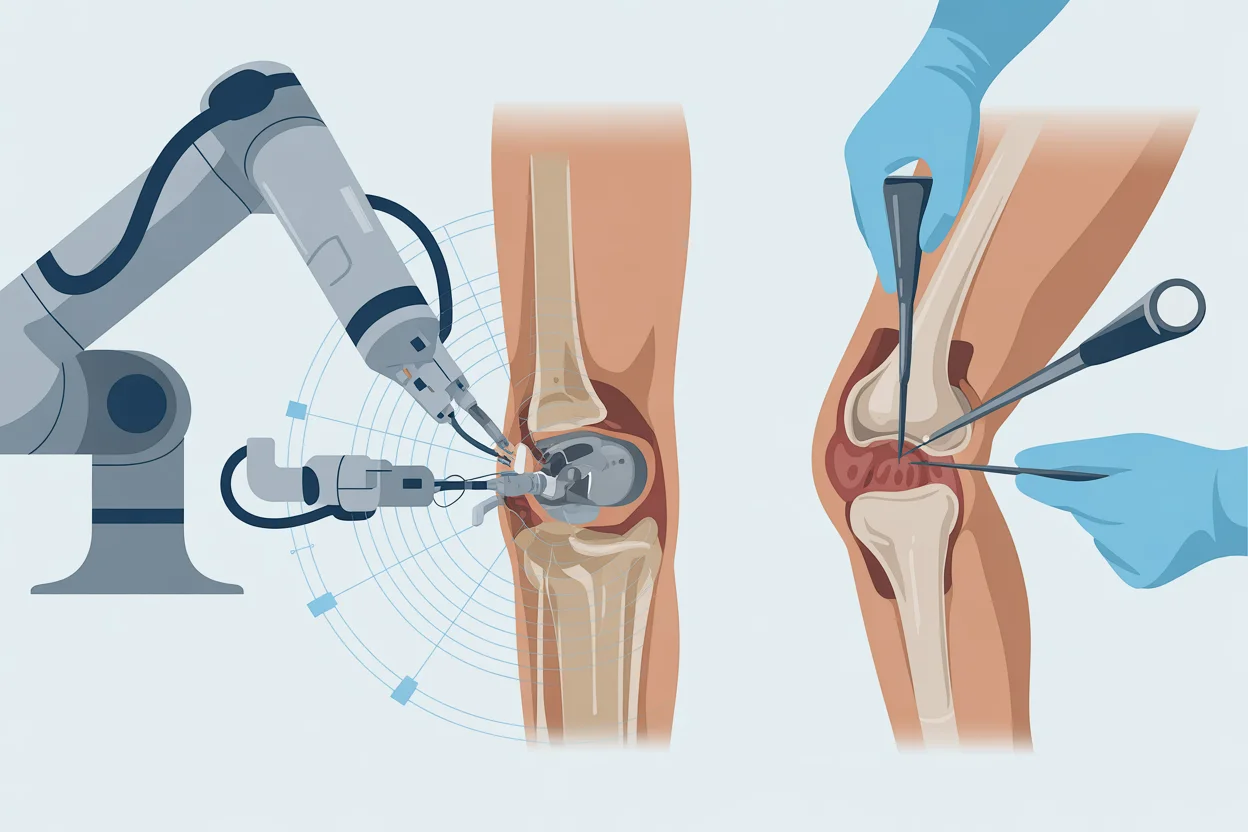
Independent systematic reviews comparing robotic-assisted and conventional total knee arthroplasty consistently find that robotic techniques achieve more accurate implant alignment and fewer positioning outliers. Where the evidence is less clear-cut is in day-to-day function: most reviews report similar clinical scores, similar pain levels and similar complication rates between the two approaches in the short to medium term.
|
Factor |
Robotic knee replacement |
Conventional knee replacement |
|
Implant alignment |
Higher precision; deviation typically under 1mm and 1 degree |
Relies on mechanical guides and surgeon judgement |
|
Soft tissue impact |
Robotic boundary control limits impact on surrounding tissue |
More variable, depending on technique and anatomy |
|
Operating time |
Often slightly longer due to scanning and planning steps |
Typically shorter |
|
Early recovery |
Some studies report less early pain and shorter stays |
Well-established, predictable recovery pathway |
|
Medium-term function |
Broadly similar to conventional in most studies |
Broadly similar to robotic in most studies |
|
Complication rates |
No consistent difference found across current evidence |
No consistent difference found across current evidence |
Research on knee replacement satisfaction consistently links a meaningful share of dissatisfied outcomes to variation in implant positioning and soft-tissue balance, one of the specific problems robotic planning is designed to reduce.
A large propensity-matched analysis published in the Journal of Orthopaedic Surgery and Research found that roughly 15 to 30% of total knee arthroplasty patients report some dissatisfaction after surgery, often tied to implant positioning and soft-tissue balance, which is precisely what robotic planning aims to tighten up.
Who Should Consider Robotic Knee Replacement Surgery?
Robotic assistance tends to offer the clearest benefit for certain patient profiles rather than being a universal upgrade. It is worth discussing with your surgeon if any of the following apply to your case.
- You have a more complex knee deformity where fine-tuned alignment is harder to achieve manually
- You are considering a partial (unicompartmental) knee replacement, where precision has shown some of the clearest research benefits
- You want the most detailed pre-surgical plan available before committing to surgery abroad
- Your surgeon recommends robotic assistance based on your imaging and knee anatomy
Not every patient needs robotic assistance for an excellent outcome. Conventional knee replacement remains a safe, effective and well-proven option, and an experienced surgeon can achieve strong alignment either way. Our guide to how MAKO robotic surgery works goes deeper into the technology itself if you want to understand the mechanics before your consultation.
Why Australians Are Weighing Robotic Knee Replacement in Thailand
Two pressures are pushing more Australian patients to look overseas for knee replacement. The first is time. National data from the Australian Institute of Health and Welfare show a median public hospital wait of around 240 days for total knee replacement in the most recent reporting period, with roughly a third of patients waiting more than a year. The second is cost. Patients who choose to self-fund private knee replacement in Australia are often quoted total costs, covering surgeon, hospital and theatre fees, in the tens of thousands of dollars once every component is included, based on Australian Government cost estimates reported by Canstar.
Bangkok has become a recognised option for both standard and MAKO robotic knee replacement, built around hospitals accredited by the Joint Commission International, the same standard used to benchmark hospital quality worldwide. Medidash Global’s partner hospital in Bangkok is Bumrungrad International Hospital, JCI-accredited since 2002, offering both standard and MAKO robotic-assisted knee replacement using the Stryker MAKO platform. Our overview of how we evaluate hospital quality in Bangkok explains what we look for beyond a hospital’s marketing.
Comparing the Cost: Robotic Knee Replacement in Thailand vs at Home
Pricing depends heavily on the hospital, the implant used and whether the quote is all-inclusive, so treat the figures below as a starting point rather than a fixed number for your case.
|
Pathway |
Typical cost (AUD) |
Typical wait |
|
Australian public hospital |
No direct charge to the patient |
Around 8 months (national median) |
|
Australian private, self-funded |
Often well into five figures once all fees are included |
Weeks, subject to surgeon and hospital availability |
|
Standard knee replacement, Bangkok |
From AU$13,000 |
Typically 2 to 4 weeks from consultation |
|
MAKO robotic knee replacement, Bangkok |
From AU$20,000 |
Typically 2 to 4 weeks from consultation |
These Bangkok figures are starting prices for standard care packages, and whether they include the implant itself varies by hospital and case complexity. Always ask your Medidash Global care coordinator to confirm exactly what is and is not included in your written quote before booking, especially the implant, before making any decision. If cost savings matter most to your decision, standard knee replacement is generally the stronger value comparison; if speed of access and surgical precision matter more, MAKO robotic knee replacement is worth the additional consultation regardless of price. To talk through which pathway fits your situation, you can speak with our patient care team for a personalized, no-obligation quote.
What to Expect: The Robotic Knee Replacement Journey with Medidash Global

- Initial consultation, where you share your imaging and medical history for a clinical review
- A personalised treatment plan and written quote, confirming whether robotic or conventional surgery is recommended
- Travel, visa and accommodation coordination for you and any travelling companion
- Hospital admission and surgery, using MAKO robotic or conventional techniques as agreed with your surgeon
- Inpatient recovery and physiotherapy before you are cleared to leave the hospital
- Post-operative monitoring once you are home, with your care team checking in as you continue rehabilitation
Recovery timelines and fitness to fly vary by patient, so it is worth reading our separate guide on flying after knee replacement as you plan your return home.
If you are weighing robotic knee replacement against conventional surgery, our team can review your case and get you a personalised quote for either pathway at our partner hospitals in Bangkok.
Frequently Asked Questions about Robotic Knee Replacement
Is robotic knee replacement better than conventional knee replacement?
Robotic knee replacement generally achieves more precise implant alignment, but most research shows similar clinical outcomes, pain levels and complication rates compared with conventional surgery in the short to medium term. The right choice depends on your knee anatomy and your surgeon’s recommendation, not on one technique being universally superior.
How much does robotic knee replacement cost?
In Australia, self-funded private knee replacement often runs into the tens of thousands of dollars once every fee is included. In Bangkok, MAKO robotic knee replacement packages through Medidash Global’s partner hospitals typically start from AU$20,000, with standard knee replacement from AU$13,000. Always confirm in writing whether your quote includes the implant.
Am I a good candidate for robotic knee replacement surgery?
Patients with complex deformities, those considering a partial knee replacement, and anyone who wants the most detailed pre-surgical plan available tend to see the clearest benefit. Your surgeon will confirm candidacy after reviewing your imaging and medical history.
How long is recovery after MAKO robotic knee replacement?
Early recovery timelines are broadly similar to conventional knee replacement, though some patients report less early pain. Most patients spend several days in hospital and continue physiotherapy for weeks after returning home, with full recovery generally taking several months.
Is robotic knee replacement safe at hospitals in Thailand?
Robotic knee replacement in Thailand is performed at JCI-accredited hospitals using the same MAKO platform used across Australia, the UK and the United States. Accreditation, surgical volume and post-operative care protocols are worth confirming for any hospital, in Thailand or elsewhere.
What is the difference between MAKO robotic knee replacement and regular knee replacement?
MAKO robotic knee replacement adds a CT-based 3D surgical plan and a robotic arm that guides the surgeon within pre-set boundaries during the cut. Regular, jig-based knee replacement uses mechanical guides and the surgeon’s direct judgement without that computer-assisted planning stage.