

Hair transplantation in the UAE can be a safe choice for international patients, provided you approach it like a regulated medical procedure, not a “package deal.” The UAE has modern healthcare infrastructure, clear licensing pathways, and internationally trained clinicians, but outcomes and safety still depend heavily on clinic governance, surgeon credentials, infection-control standards, and transparent aftercare planning, especially if you are flying in and leaving shortly after treatment.
This article explains how to evaluate whether a hair transplant in the UAE is safe, what to check before you book, how the process typically works for international patients, and how to reduce avoidable risks.
Is it safe to get a hair transplant in the UAE if the clinic is properly licensed?
In general, the UAE can be a safe destination for hair restoration when the procedure is performed in a properly licensed facility by an appropriately licensed clinician, with clear pre-op screening and structured post-op follow-up.
What “safe” typically comes down to in practice:
- Regulatory oversight: Healthcare facilities and professionals are licensed by the UAE health authorities (which vary by emirate).
- Clinical standards: Many facilities operate with strong infection-control protocols and modern equipment.
- Provider variability: The UAE has excellent clinics, and also clinics that rely heavily on marketing. Due diligence is essential.
If you want to understand the UAE’s healthcare framework and patient-facing services, see the UAE government health services.
Is it Safe to Get a Hair Transplant in Dubai versus Abu Dhabi or Other Emirates?
Safety is less about the city and more about who regulates the facility and who actually performs the procedure.
Key regulators to know:
- Dubai: Dubai Health Authority (DHA)
- Federal (incl. some northern emirates): Ministry of Health and Prevention (MOHAP)
Practical takeaway:
- Ask the clinic which authority licenses them and request the facility license number.
- Verify the treating doctor’s license (not just the clinic brand).
- Confirm if the procedure is done in a hospital, day surgery center, or outpatient clinic, and what emergency protocols exist on-site.
Is it Safe to Get a Hair Transplant in the UAE with FUE or DHI Techniques?
Both FUE (Follicular Unit Extraction) and DHI (Direct Hair Implantation) can be performed safely in the UAE. However, technique names are not a substitute for clinical quality.
Safety and quality depend on:
- Appropriate patient selection (donor capacity, pattern of loss, scalp health).
- Anesthesia safety (usually local anesthesia; protocols vary).
- Team roles and supervision (who extracts grafts? who makes recipient sites? who implants?).
- Graft handling and timing (temperature control, hydration, minimizing out-of-body time).
Important: Results vary by individual case, and a proper consultation is essential.
Is it Safe to get a Hair Transplant in the UAE if Technicians do Most of the Work?
This is one of the most important safety and ethics questions to ask.
In many markets, hair transplants may involve a team where technicians assist with graft handling or implantation. The key issue is clinical accountability and scope of practice:
- Who performs the medical parts of the procedure?
- Is a licensed physician present throughout and actively supervising?
- Who designs the hairline and makes the incisions/recipient sites?
Ask for a written breakdown of roles:
- Surgeon/physician: consultation, hairline design, anesthesia oversight, incisions, complication management.
- Technicians/nurses: graft sorting, assistance with implantation (varies by clinic policy).
If a clinic won’t clearly explain who does what, treat that as a red flag.
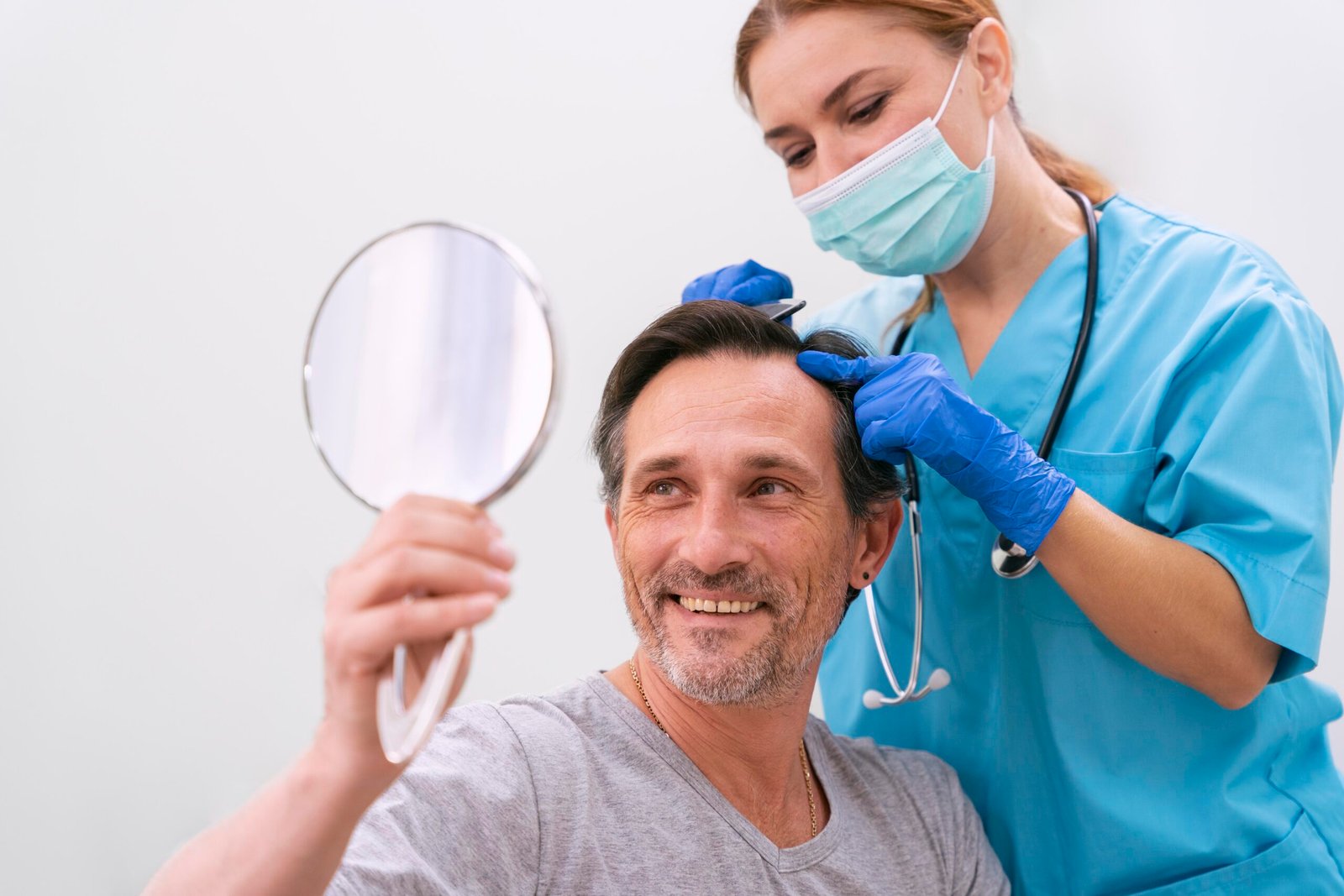
The Quickest Safety Checklist Before You Book a Hair Transplant in the UAE
Use this checklist to avoid the most common international-patient problems (hidden costs, unrealistic plans, poor aftercare, and unclear clinical responsibility).
Clinic and surgeon verification checklist
- Confirm the facility is licensed by DHA/MOHAP (or relevant authority).
- Confirm the treating clinician is licensed and ask for:
- Full name and registration details
- Specialty background (dermatology, plastic surgery, etc.)
- Ask how many hair restoration cases they do per month/year.
- Request recent, high-quality before/after photos with similar hair type and pattern.
Procedure and planning checklist
- Ask for the proposed graft range and what it is based on (donor analysis, density targets).
- Confirm the technique and what “DHI” or “FUE” means in their workflow.
- Clarify whether beard/body hair is used (if relevant), and the risks/limitations.
- Confirm that an in-person assessment will happen before finalizing the surgical plan.
Safety and infection control checklist
- Ask where the procedure is done (clinic OR vs procedure room), and:
- Sterilization process
- Single-use consumables policy
- Emergency response protocol for fainting, allergy, and bleeding
- Understand typical side effects vs complication signs:
- Expected: swelling, scabbing, redness, temporary shedding
- Needs review: increasing pain, fever, spreading redness, pus, sudden swelling
Cost and transparency checklist (to prevent “surprises”)
- Request an itemized quote that includes:
- Consultation and scalp analysis
- Procedure cost (and what graft count range it covers)
- Medications/aftercare kit
- Follow-up schedule (remote/in-person)
- Ask what is not included (extra sessions, PRP add-ons, hotel transfers, revisions).
A Step-by-Step: What a Safe UAE Hair Transplant Journey Usually Looks Like
A structured process reduces risk, especially when travel timing is involved.
- Remote pre-assessment
- Photos in standardized lighting and angles
- Medical screening questionnaire (meds, allergies, smoking, bleeding risk)
- Preliminary graft estimate (range, not a single “guaranteed” number)
- Clinic verification and consent
- Confirm facility/doctor licensing
- Review consent forms, risks, and the expected recovery timeline
- Align expectations: density, coverage, and timeline (months, not weeks)
- Arrival and in-person consultation
- Donor assessment (density, caliber, miniaturization)
- Hairline design discussion (age-appropriate, long-term plan)
- Final treatment plan and revised quote if needed
- Procedure day
- Pre-op photos and markings
- Local anesthesia
- Extraction, site creation, implantation
- Post-op instructions and immediate review
- Immediate aftercare (days 1–7)
- Wash protocol and swelling management guidance
- Activity restrictions
- Clear contact channel for concerns
- Follow-up plan (weeks to months)
- Scheduled check-ins (often remote)
- Guidance on the shedding phase and growth timeline
- Assessment for any corrective steps if concerns arise
Safety Risks to Understand (without exaggeration)
No surgical procedure is risk-free. A balanced view helps you plan properly.
Common, usually temporary effects:
- Swelling of the forehead/around the eyes
- Redness and scabbing
- Itching and mild discomfort
- Shock loss (temporary shedding)
Potential complications to discuss during consultation:
- Infection (rare with proper protocols, but possible)
- Folliculitis
- Poor growth/yield due to handling, trauma, or unrealistic graft planning
- Donor overharvesting and visible thinning/scarring
- Unnatural hairline design (often a planning issue, not a technique issue)
A proper consultation is essential to evaluate your individual risk factors.
How to Reduce Risk if you are Flying in for a UAE Hair Transplant
International patients face a specific challenge: aftercare happens when you’re no longer there.
Risk-reduction steps:
- Stay in the UAE long enough for an early review (often 24–72 hours depending on provider protocol).
- Confirm you’ll have:
- A dedicated aftercare coordinator contact
- Written emergency guidance
- Remote follow-up schedule
- Avoid booking return flights that force you to rush discharge instructions.
- If you have a history of keloid scarring, bleeding disorders, or complex medical issues, discuss this early (and consider whether a hospital-based setting is more appropriate).
Comparison Table: What “Safe Clinic Signals” Look Like in the UAE
| Area | Safer indicators | Red flags |
| Licensing | Facility + doctor license provided; regulator named (DHA/MOHAP) | Vague answers: “We’re certified” without details |
| Medical leadership | Doctor-led consult, clear accountability | Sales team drives plan; doctor unavailable pre-op |
| Treatment plan | Graft range with donor rationale | One fixed number promised; “maximum grafts” pressure |
| Infection control | Clear sterilization, single-use items explained | Unclear OR standards; rushed turnover |
| Transparency | Itemized quote; written inclusions/exclusions | Hidden add-ons; unclear medication/aftercare fees |
| Aftercare | Structured follow-up schedule and contact | “Message us if needed” only |
Where Medidash Global helps (without acting as a clinic)
Medidash Global is a medical tourism consultant and patient coordinator, not a clinic. For safety-focused patients, the practical value is in reducing uncertainty and helping you compare options logically.
Typical coordination support can include:
- Shortlisting vetted, reputable providers
- Verifying what documentation to request (licenses, quotes, aftercare plan)
- Helping you compare clinics on process and governance, not hype
- Planning timelines so you’re not forced to travel immediately post-procedure
Additional Reading and Useful Resources
For official UAE healthcare information and regulator references:
If you’re also planning a longer stay in Thailand for treatment or recovery and want practical lifestyle preparation, you may find this useful:
Final Guidance: When a Hair Transplant in the UAE is a Sensible, Safety-first Choice
A hair transplant in the UAE can be a sensible option when you can verify licensing, confirm who performs each step, receive an individualized graft plan based on donor capacity, and secure a clear aftercare pathway that still works after you fly home.
If you want to proceed cautiously, focus your decision on documentation, clinical accountability, and process transparency. Results vary by individual case, and a proper consultation is essential.